 "We Were The Best There Ever Was."

During all this, the 127th Airborne Engineers labored to build a causeway inland… which kept sinking into the swamp to their front which was the outskirts of Lake Bito. And the monsoon rains which started on Day 2 didn’t help; it rained on average 1 inch a day for the next 30 days and as one Angel wrote, “this whole island is one sea of mud”. It took four days for the engineers to complete what the Division called “Highway 1” and in the meantime, a nearby AmTrac battalion began shuttling about 50% of the rain-soaked Angels inland. And with good reason.
Originally, the Division was only going to stage on Leyte before heading north to fight on Luzon, but Allied operations had stalled around Leyte’s central mountain range. It was General Douglas MacArthur himself who asked the 11th Airborne’s CG Major General Joseph Swing if his boys could handle taking over the area assigned to the 7th Infantry Division. Swing said, “Sure, of course we could”, so the General’s Angels were assigned to, quote, “relieve the 7th Infantry Division along the line Burauen-La Paz-Bugho and destroy all the Japs in that sector.”…
FINALLY, the 11th Airborne was going to get into the fight, and Burauen became the central location in the Division’s Leyte campaign with General Swing’s CP set up near San Pablo Airstrip Number One. And this move was actually pretty tough to complete. I recently found a map in a journal from the Division’s 408th Quartermasters Company and all the roads around Burauen are marked as “impassible”. But the hardworking Angels pushed foward towards the mountains where the 11th Airborne would face Japan’s 16th and 26th Infantry Divisions. The 16th had participated in the Rape of Nanking and the 26th had captured Corregidor in 1942 then perpetrated the awful Bataan Death March.
It was the 11th Airborne’s 511th Parachute Infantry which spearheaded the Angels’ push up and across the mountains and these tough, elite Paratroopers helped eliminate nearly 6,000 of the Butchers of Bataan and the Ravagers of Nanking. In the words of H Company’s PFC Richard Keith who would go on to retire a Major General, “The ghosts of Bataan were partially avenged by the 11th Airborne Division in the gray, unforgiving mountains of Leyte."
General Keith’s 511th PIR would suffer 75% of the 11th Airborne’s casualties on Leyte and at first those casualties had to be hand-carried back to Burauen which meant stretcher parties of between 8 to 12 soldiers. So, with every new casualty, fighting strength diminished and it was a HARD hike back down out of the mountains carrying a wounded buddy on a stretcher.
RHQ’s PFC John Kuntz said with some humor, “Leyte is a mountainous, swampy, hot, wet, cold, and dry place, with one peculiar feature that I remember very, very well—all the mountains go UP. There is not a single downslope in the entire place. I am prepared to take an oath to the effect.”
The solution to accelerate casualty evacuation AND resupply was to create a forward position that would grow to include an air strip, a supply depot, a cemetery, and medical facilities which allowed casualties to be treated quickly AND permit convalescence closer to the frontlines.
As one after action report noted, Manarawat “deserves to live in the memory of the Division forever.” So, all you Arctic Angels reading today, remember the story of Manarawat.
Measuring about six hundred feet by two hundred feet, Manarawat sits just south of Lubi and rises about 150 feet in elevation. It was a great defensive position since it is surrounded on three sides by sheer cliffs with the fourth side consisting of a gradual slope, although the surrounding foliage DID provide the enemy with plenty of vantage points for snipers.
Given its distance inland, and the lack of reliable roads, resupply at Manarawat was mainly by L-4 and L-5 liaison planes, although there were occasional C-47 drops. But the use of C-47s on Leyte was extremely limited since most of the island’s airstrips were packed with fighters and bombers and Sixth Army only had about 6 C-47s from the 11th Air Cargo Resupply Squadron and those were either under repair or busy shuttling supplies around the island.
The 11th Airborne’s entire Manarawat undertaking was called Operation Tabletop, and it really started late on November 26, 1944, when the 511th Parachute Infantry’s 1st Battalion under Lieutenant Colonel Ernest LaFlamme was told to clear and secure the first Drop Zone east of the plateau. Efforts got underway two days later and were performed by none other than Company B, the same Angels who would make the famous drop on Luzon’s Los Banos Internment Camp three months later.
Actually, it was just B Company’s 1st and 2nd Platoons doing the work while 3rd Platoon was sent to patrol north of Lubi which the Angels called “Mayfield” over their radio net.
This was all AFTER the company had to wait for the Daugitan River to stop raging so they could cross it.
On November 27th, the 511th’s 1st Battalion Headquarters and Headquarters Company set up a perimeter at Manarawat while the rest of the regiment’s companies moved around between Burauen, Lubi, and Anonang. There’s a funny radio message from one company commander at the time who when asked what his location was, he replied, “I wish to Christ I knew.”
But the 511th’s 3rd Battalion also reached Manarawat before heading west to Mahonag on December 5th, and PFC Robert LeRoy said, “This mountain top resembled a huge loaf of French bread. It had steep sides, but more gradual slopes at each end. Our machine gun positions were about one hundred yards apart, with riflemen stationed in foxholes every ten steps apart.” More on those defenses later.
But as the 511th continued to lead the Division’s push westward, even past Manarawat, they were moving out of range of their artillery at Burauen, and even the 155mm Long Toms at Tacloban, so the question became how to continue to offer fire support as the campaign progressed? The answer was obviously to move guns into the hills but remember the trek into the mountains from Burauen was brutal and even native Carabao struggled to make it. When the Angels tried, several carabao fell off cliffs and died, taking their packed cargo with them.
And the “roads” were washed out and so muddy that Jeeps and trucks couldn’t get past Calaghosan, so ultimately the solution was to airdrop gun crews from the Division’s 457th Parachute Field Artillery onto Manarawat.
However, as I mentioned, there were almost no C-47s available and those that WERE available were busy flying supplies, plus the monsoon weather really made flying a C-47 into the mountains extremely dangerous.
In fact, one C-47 crashed while trying resupply the Angels.
But the ever-enterprising Angels DID find one C-47 devoted to search and rescue operations out of Tacloban who told Colonel Nicholas Stadtheer that he would help the Division when he wasn’t flying CSAR missions.
So, on December 2, Battery A of the 457th Parachute Field Artillery fixed six parapacks, or paracaissons, to the undercarriage of this willing pilot’s plane. Colonel Stadtheer wanted to fly out that evening, but the aircrew said the weather was too dicey, so they had to wait until the next day, December 3rd.
With RESCUE painted in large yellow letters on the side of the craft, the artillery men helped the aircrews remove and tape around the plane’s door so the jumpers could make their exits. Taking off from Tacloban, the craft flew towards Manarawat with a Drop Zone two miles from the battery’s future position where Colonel Stadtheer acted as jump master. This was jumpers only and the GO signal was going to be given on the ground by Lieutenant Foster Arnett who would tell Colonel Stadtheer “Do Not Jump” on the radio if the DZ was hot.
But things went SO smooth during the first jump that the Colonel decided he could hit the small “clearing” on Manawarat itself to save his men a back-breaking trek to the plateau, so there were two DZs involved in the Angels’ first combat drops. The second became Manarawat’s main drop zone and was called “DZ 6”. And it was NOT an easy flight path for the pilot to hit DZ 6.
G-511’s PFC George Doherty described the procedure for dropping on Manawarat, saying:
“The high mountains surrounding the plateau forced the pilot to follow a moon shaped canyon to the approach run, dive down like a fighter plane and zoom sharply up and to the left when he passed the drop zone, dropping one wing almost perpendicular to the ground which enabled him to slip between two sharp peaks.”
Some skilled flying and after the jumpmaster shouted ‘Gooooooo!’ the 457th’s Paratroopers exited the craft, after which the pilot had to pull up sharply to avoid crashing into the surrounding hillside, a feat he completed thirteen times to move A Battery to their new home with Colonel Stadtheer acting as jumpmaster every trip. Due to the nature of the DZ, only three of four Angels could jump during each pass.
PFC Deane Marks of HQ2-511 remembered watching these first drops. He said:
“About two or three hours after we set up our LMG (Light Machine Gun), we looked out into this valley, and ‘holy cow’ here came this C-47 barreling at eye level at perhaps a thousand yards to our front. Right in front of us a slew of red and yellow parapacks dropped and troopers started jumping out of the plane. We could actually see their little white faces. They couldn’t have been higher than four or maybe five hundred feet….”
Let’s hear it for the King of Battle!
ALL of Battery A was assembled on the strip by 0830 on December 6, but another message notes that they fired their first rounds at 0840 on December 5th, one day after their drops. Battery A’s CO was Lieutenant Milton Hollaway, but everyone called him “Jelly Belly” because, well, you can guess why.
Operating under the radio code name of “Gold Able” and “Gold Dog”, the 457th’s support would prove critical in the weeks ahead. For example, when the 511th PIR’s Paratroopers from 1st and 3rd Battalions hit a massive enemy force outside Anas on December 20th, the 457th’s guns on Manarawat fired 120 rounds in support, allowing the Angels on the ground to take what they were calling The West Ridge.
But three weeks earlier back on Manarawat there were now elements of the 511th’s 1st Battalion and one battery from the 457th Parachute Field Artillery on Manarawat with their four 75mm pack howitzers. However, the 511th had been selected to lead the fight in the mountains by taking Mahonag then cutting the enemy’s supply line through the Mahonag Pass, so most of 1st and 3rd Battalions were preparing to push forward.
Someone needed to come help the 457th hold the plateau because the Japanese would quickly notice the Angels’ presence and banzai attacks, snipers and night infiltrations would quickly become common. These reinforcements COULD hike inland from Burauen, which would take two days, OR they could be dropped right onto Manarawat which made more sense. But given the difficulty of dropping the artillery men from a C-47, eleven of the 11th Airborne’s spotter planes were utilized to jump, one at a time, a platoon from the187th GIR’s Company C to provide security for Manawarat until December 18.
These 24 men were under the command of Lieutenant Chester W. Kozlowski, a Paratrooper from the 503rd PIR who had transferred to the 11th Airborne after the 503rd’s Noemfoor operation. The rest of the 187th’s Company C would arrive on December 5 under Lieutenant Charles “Pop” Olsen. Chester said for these jumps the Angels would clip their static line to a D-ring inside the Piper Cub and they would sit with their feet out the door. When the pilot raised their hand, it was like the green light and C Company would jump out. They noted that the opening shock was nothing like a C-47, it was almost soft
This freed up the regular Paratroopers from 1/511 to move into the jungles to face the enemy, though 3/511 briefly joined 1st Battalion on Manarawat before heading west. On December 2nd 3rd Battalion attacked an enemy force just west of Manarawat, killing 25, and oddly enough, among the dead they found Japanese soldiers wearing American jump boots, probably taken from Angels who had been recently killed.
But the 187th GIR’s jump on Manarawat made the C Company men the first tactical unit to EVER make a parachute jump in a combat zone from LIASON craft, something that is usually overlooked in the list of the 11th Airborne’s accomplishments during the war. And the reason C Company could make that jump even though the 187th WAS a glider regiment was because back on New Guinea during the summer of 1944, Major General Joseph Swing had ordered a jump school set up and the 187th’s men were cycled through abbreviated parachute training.
PFC Clifton Evans of RHQ-187th wrote home after his qualifying jumps on New Guinea:
“I like jumping much more than riding gliders. It’s almost impossible to explain the thrill in jumping. It’s just one of those things you have to do yourself to know what it’s like. I sure sweat every jump out, but it’s worth it. I really feel I accomplished something in overcoming my better judgment because when you sit in that plane the same question always pops through a guy’s mind – ‘what the hell am I doing up here?’ – but I still like it.”
Maybe some of you Paratroopers can relate!
The 187th GIR’s Joseph Giordano, who jumped on Manarawat, noted that the plateau, “was one of the few semi-cleared areas in our entire zone of action, and while it was not well suited for an airstrip, it was well located, and a shade better than nothing.”
That said, it WAS decided that an airstrip was desirable on the plateau to help with resupply, troop movement and casualty evacuation. The casualty evac was really the initial problem to be solved after the 511th’s Company C and some elements of RHQ were ambushed by an enemy force. A radio message was sent back to Division at Burauen which said, “Need method of evacuation of casualties, suggest L-4. Need Medical attendance.”
To make this all possible, some Angels from Division HQ and a platoon from Company C of the 127th Airborne Engineering Battalion jumped on Manarawat to clear a larger landing area with picks, shovels, axes, and explosives. This, of course, increased the range of the division’s small craft for artillery spotting, unit locating and the evacuation of casualties.
Some of the Angels on the plateau remembered hearing “Fire in the hole!” before the 127th’s engineers blasted out trees, stumps and other obstacles to help clear the airstrip.
Now this tiny little strip hacked and blasted out of the jungle became known as Randolph Field. If you know your World War II aviation history, that name might sound familiar because it was the name of a major training base in Texas where several of the 11th Airborne’s liaison pilots had trained, so they elected to call the airstrip on Manarawat “Randolph Field” to honor their aviation beginnings.
Now I mentioned how hard it was to carry the wounded on stretchers back down from the mountains to Burauen. I wanted to read a description of this process written by A-511’s PFC Steve Hegedus. He said:
“Carrying a stretcher up and then down four steep, slippery, muddy hills is next to impossible; trying to be gentle and caring to the man on the stretcher is even more exasperating. Some places, the trail was so steep, that the men in front were facing backwards, holding the stretcher on their knees, while the men in back were holding it shoulder-high, and the four relief men were trying to keep the four carriers from falling or slipping, or tripping, or dropping their end.”
This was time- and manpower consuming, so it was decided that in addition to building the airstrip, medical personnel from the 221st Airborne Medical Company would be airdropped onto the plateau along with equipment for a Portable Surgical Hospital. Some of this drop was filmed by an Army Signals unit, so hopefully I can share the footage soon once I get a copy from the National Archives.
But I see this photo all over the place when the 11th Airborne’s Leyte campaign is mentioned. The wounded Angel on the stretcher is actually being carried TO Manarawat where three surgeons, ten surgical technicians and other medical staff worked out of a thatched and parachute-covered bamboo structure, and you can see some of their work in these photos…
“Those Medics did a fantastic job under the conditions they encountered,” my grandfather 1st Lieutenant Andrew Carrico noted. H-511’s PFC Jerry Davis, who later became a doctor himself, wrote, “These surgeons often worked and did miracles under circumstances which would make the men of ‘M.A.S.H.’ look like they were performing with the latest hi-tech material and equipment.”
Steve Hegedus added, “I have often said that the level of medicine on Leyte was closer to the Civil War 80 years before, than to M.A.S.H. in Korea, 8 years later.”
Once the wounded were stabilized at Manarawat, they either recuperated there then returned to their units or 46 Angels needed further care and were flown to San Pablo then on to larger hospitals at Dulag (or even back to the states) for treatment. You can kind of see in this photo the Angels’ medivac solution, they built a plywood shelf to sit behind the pilot who would then fly the casualty out.
Those who stayed on Manarawat to recuperate were often placed two in a foxhole, one Angel who was more wounded than another so the one in the least pain could help encourage and care for his foxhole buddy, and they could keep each other warm through the cold nights.
There’s a funny story of one Angel who was carried to Manarawat for surgery on his leg wound. Well, he woke up from the anesthesia to find his leg AND his left arm bandaged and splinted. Confused, this Paratrooper called out to a nearby medic, “Hey Doc! I thought I was hit in the leg.”
“You were,” said the medic. “But you were in no condition to duck ration boxes. So, now you also have a broken arm.”
Since Manarawat could not be reached my mechanized transportation, all resupply was done by air and an airdropped ration box had crashed through the roof of the “hospital” while this trooper was in surgery. The box hit and broke his left arm while he was knocked out, so the trooper grumbled, “This damned war is full of nasty little surprises.”
And this WAS an issue on Leyte. The Division’s liaison planes would fly overhead and drop rations, ammunition, medical supplies, and occasionally, ice cream from the Division’s ice cream machine at Burauen. I should point out that supplies were stockpiled at Burauen where the L-4s and L-5s would load up to head into the mountains to make their drops, and the Division’s 408th Quartermaster Company deserves a lot of credit for keeping the supplies flowing.
And as part of the 408th’s efforts, you can see some of the Division’s riggers working on supply bundles in this photo here…. And if you ever find yourself visiting Burauen today, you’ll find this airstrip’s Marston Matting being used in local gardens, as fencing, “sidewalks”, animal stables and so on.
But back in 1944, after loading up at Burauen the 11th Airborne’s L-4s could carry about 200 pounds of supplies while the L-5s carried about 400 pounds. I found a note in a record from the 408th Quartermasters journal which said that one L-5 could carry four cases of rations, either four 10-in-1s or four C- or K-Ration crates. Each plane flew about 15 loads a day and at its height, the Division was flying over 170 sorties a day while moving about two tons of supplies, which, of course, stalled for about four days when Japanese Paratroopers dropped onto the 11th Airborne’s units at Burauen, but that is a story I’m going to tell another day.
5th Air Force did send six replacement L-5s after the enemy attack, but the Angels called the Liaison planes “Little Birds” while C-47s were, of course, “Big Birds”. And if not for these courageous pilots, the 11th Airborne’s troopers fighting in the mountains would have had to stop their forward progress or even pull back to Burauen for resupply.
My grandpa who was fighting with the 511th’s Company D said, “What saved us was the piper cubs, the small planes. Those pilots, they’d fly right over us and ask, ‘You guys hungry down there?’ We’d shout back ‘Yes!’ and they’d just push the cartons of food out.”
HQ3-511’s PFC George Doherty said, “Most of the credit for the Leyte campaign is given to the infantry, but without the unsung help of the service troops and liaison pilots flying under impossible conditions no matter how good we were, we couldn’t have survived on leaches, snakes and roots of trees like the Japanese did.”
And these pilots were not content with just flying alone. No, the Angels’ flyers would also carry Thompsons, grenades, even mortar rounds which they would use to “attack” any enemy squads they saw on the ground. Every Angel is a fighting Angel and when asked about it, the pilots said it gave them a break from the monotony of flying all the supply drops.
And they WERE fired on by the enemy as well, sometime when dive bombing, sometimes when taking off or landing, and sometimes just on the ground. During their pre-dawn or post-sunset flights, these pilots would keep their eyes out for Japanese cooking fires and then call in artillery strikes on the enemy positions, a tactic the Division had great success with through December. The pilots would also drop these leaflets over enemy troops which invited them to surrender to the Americans and gave them instruction on how to do so...
As you can imagine, not many Imperial soldiers took advantage of the offer.
I’ve always loved this sketch of one of their Piper Cub rescuers which was drawn by RHQ-511’s PFC Frank Lewis. Frank reenlisted during the Korean War where he continued drawing, often lampooning officers with his cartoons to entertain his fellow soldiers. After serving again in Vietnam, he would go on to become a famous syndicated newspaper cartoonist, and you can find his work online. When asked about his awards by some journalists, Frank just said he had, quote, “A few Silver Stars and a few Bronze Stars.” No big deal.
Speaking of stars, Frank served in RHQ alongside this guy who you might recognize. Rod Serling, the creator of The Twilight Zone...
But back in 1944, Frank, Rod and their fellow Angels fighting on Leyte were kept alive by the Division’s liaison pilots and this WAS dangerous flying, let’s not discount that. Using only basic instruments and their instincts, these pilots were flying through steep mountain terrain which was often covered by thick clouds or fog, and they had to dive low to drop supplies which left them within small arms range of nearby enemy.
1st Lieutenant John Ricks, for example, from the 457th Parachute Field Artillery was one of these daring pilots who risked their lives every day making these flights from Burauen to Manarawat and then on to frontline units. On December 9, Lieutenant Ricks’ plane went down in the mountains around Manarawat and he was killed. I’ve never been able to discover if it was enemy fire which brought his plane down, mechanical failure or if he clipped a tree or mountainside.
Four months after his death, on April 3, 1945, to celebrate what would have been John’s 30th birthday, his wife Edna published a poem in their local newspaper that I’d like to read to you. She wrote:
“In loving memory of my husband…who gave his life on Leyte.
He is not really lost to me
Though he has passed away.
In memories that shall never fade
He’ll live for me each day.
And in the knowledge that he went
Bravely, without regret,
I know he went to God content
To do the task he met.
His spirit will live on with those
Who fought for liberty,
And he will be forever young
Who died to keep men free.”
Edna and John had only been married about three years when he was killed. Lieutenant Ricks’ remains WERE later recovered and he is now buried in the beautiful Manila American Cemetery with so many of his fellow Angels.
Despite the dangers and their losses, the 11th Airborne’s continual resupply operation during December of ’44 kept Manarawat functioning and also allowed rations and ammunition to be carried to frontline units. And yes, sometimes C-47s out of Tacloban were used to make the drops, the first being guided by the 511th’s 1st Lieutenant Bill Abernathy, but boxes dropped from a C-47 frequently came crashing down at dangerous speeds, as was noted by PFC George Doherty of the 511th’s Company G.
I was recently able to visit George’s grave and pay my respects at the Riverside National Cemetery, but he said of the Leyte airdrops:
“When the cargo chutes opened, the boxes of supplies on occasion would slip out of the cargo chute holders at 125 miles per hour, striking trees they would bust apart and scatter in all directions like an exploding artillery shell. A C-ration can would then become a lethal projectile as many of them did...”
George’s 3rd Battalion spent some time on Manarawat and during one drop from a C-47 on December 5th, a baseplate from an 81 mm mortar was attached to a parachute and pushed out the open door. Well, the baseplate ripped right through the container it was in and hurled right to the ground where it landed on and killed George’s buddy, PFC Jack Jones, who was asleep in his pup tent.
K-ration boxes were also dangerous and would drop like a bomb because the pilots usually just pushed them out without a parachute, and this resupply effort was being utilized to keep ALL the Division’s frontline units fighting, so this wasn’t just a Manarawat experience. I’m still trying to narrow the statistics down, but I estimate that between 10-30 Angels were killed on Leyte by these falling resupply “bombardments”, and dozens more were injured.
And as you can see in this photo, yes, sometimes those crates damaged the landing strip on Manarawat, so the Angels just made repairs as things went along.
So Manarawat became a pretty popular place, and all the personal and equipment parachutes were utilized by the Angels to cover their foxholes and other fighting positions, along with their radio huts, medical huts, piles of supplies, and so on. One nickname given to Manarawat was “Rayon City” due to the number of parachutes used this way which you can see in this photo. At one point there were about SEVENTY parachute-covered positions or structures on the plateau, and I don’t know if it’s related, but at one point the Division received a message saying that the C-47s were almost out of equipment parachutes.
I wonder if they were all being used for shelter at Manarawat, but we also have to remember that the various resupply parachutes were color-coded, so all these parachutes would be different colors which is why I once heard Manarawat called “Carnival City”.
And every soldier knows to keep improving their fighting position, so the Angels took additional parachutes and used them as pillows or lined their foxholes with silk. 1st Lieutenant Bill Abernathy wrote to his girlfriend Naomi, “Have been sleeping on my chute at night. Whatta bed!”
Manarawat was a crucial forward position that kept the 11th Airborne’s Angels fighting in the mountains and provided life-saving medical care for the wounded, not to mention the absolutely necessary fire support offered by the 457th’s 75 mm guns on the plateaus. And the 457th’s D Battery did make its way to the plateau on December 18th to reinforce A Battery which allowed the 187th’s Company C to join the rest of 1st Battalion at Anonang after elements from the 188th Glider Infantry arrived.
But it shouldn’t come as a shock to anyone that the Japanese wanted the Angels off Manarawat and General Swing’s troopers endured numerous attacks, including one that lasted for hours. One foggy morning, December 16th to be exact, the Angels could hear the Japanese moving through the jungle down below the plateau, so they just hunkered down in their foxholes and readied their weapons. When the enemy finally charged, the Angels opened fire and four hours later 32 Japanese were dead and countless had been wounded. Manarawat’s defenders did not lose a single man in the attack, though two men were wounded themselves.
Earlier this year I came across this map of the Angels’ defenses on the plateau that was buried in some archives. You can see the markings for the 457th’s 75 mm guns, plus the other units’ LMGs, foxholes, minefields, 60 and 81 mm mortars, BARs, and so forth. Quite the case study for defensive positioning and this map must have been drawn up after December 18th when the Division’s 188th Glider Infantry marched to Manarawat to take up position there at 1500.
In addition to all the other units at Manarawat, the headquarters group from the 511th Signals Company also parachuted onto the plateau as did some of the 11th Airborne’s famous Recon Platoon. In total, 241 Angels jumped on the plateau, so you can see why Manarawat absolutely should be counted as the 11th Airborne Division’s first combat drop of the war.
Communications on the plateau was, of course, a vital part of the day-to-day operations and while miles of communication wire were laid on Leyte by the Angels, the Japanese would just cut a wire and wait for the repair party to arrive and then kill them. And the 511th’s CO Colonel Orin “Hardrock” Haugen requested that he not longer be required to send messengers back to Burauen since it was requiring too many men on security, something General Swing agreed with.
As a solution, the 11th Airborne setup a radio net along their line of march called The Godfrey Relay which utilized small radio teams manned by the 152nd Anti-Aircraft Battalion who didn’t have much to do since Japan was lacking in air power at the time. These small radio squads set up at different points about a mile apart between Burauen and the frontline units and one squad set up on Manarawat with the radio call-sign of “Godfrey 12”.
The operators for Godfrey 12 set up in the native hut in the background of this photo…
And I’m still looking for a map of where Godfrey Six was located, but I found this handwritten message that says, “Attention Glider Six – Godfrey Six is violating security by discussing too much operational info on his 609”, or his radio. I can only imagine how that conversation went for poor Godfrey Six….
The 511th Signals also dropped a radio squad on Manarawat, but they reported they were going to shut down at night because they were drawing enemy fire. Their message sent to Division actually reads, “Every time we receive or transmit on SCR 694, (the type of radio they were using), after dark we draw fire, so silly messages such as were coming last night from G-4 and Signals should stop.”
Well, that did not go over well with General Swing who sent his assistant division commander Brigadier General Albert “Big Al” Pierson and his G-3 Major Douglas Quandt to Manarawat to, quote, “straighten things out.” Major Quandt actually parachuted onto the airstrip on December 4th and General Pierson flew in on an L-4 on December 6th, but as you can imagine, after their arrival the Signals boys made sure to stay operational after that visit.
When the 511th’s Company B came back to Manarawat after a patrol, the exhausted, muddy and wet Paratroopers sat down and one Angel told his buddies, “Boy, I would give anything for a pair of dry socks.” Well, five minutes later a pair of new, dry socks landed in his lap. Everyone looked up to see Brigadier General Big Al Pierson standing there. They had been his socks, but the General always looked out for his boys.
Well, the Division’s operations on Leyte officially ended on Christmas of 1944, although “mopping up” operations continued another week or so. The Angels of the 187th and 188th Glider Infantries were still engaged and were told, quote, “Merry Christmas and Go to it.”
I like the note sent throughout 24th Corps which says, “Swing does not need or want rescue. Swing says also he can handle all Japanese in the pass…” And he was right: his 11th Airborne eliminated nearly 6,000 of the enemy in just 33 days.
The Angles who could do so came down from the mountains to regroup on Ormoc Bay before heading back to Bito Beach on the island’s east coast. But there were still some Angels at Manarawat who were too sick or too wounded to be moved, so Major General Joseph Swing had his L-5 pilots load up canned turkey, cranberries, asparagus, nuts and hard candy for a Christmas dinner on the plateau. You can see some of the Angels on Manarawat carrying boxes of canned turkey here…
And this is a photo of the recuperation ward on the plateau, so a lot of these Angels were still there on Christmas Day. And everyone on the plateau perked right up when Division sent a radio message stating, “Be alert for possible hostile parachute landings on Randolph Field tonight or tomorrow”. An enemy plane was spotted circling the strip on the 23rd and 24th, but luckily no attack ever came.
The 11th Airborne’s famous Swing Band also hiked into Manarawat on December 18th, while their instruments were flown in on L-4s and the Angels recuperating in the plateau’s hospital appreciated singing Christmas carols together while the band played on Christmas Eve and Christmas Day. And I’ve had a hard time pinpointing exactly when, but I do know that the Division flew a movie projector up to Manarawat from Burauen to allow the Angels stationed there to enjoy some entertainment.
The Band’s presence and the movie projector were also enjoyed by the Angels of the 188th Glider Infantry who were fighting near Lubi until December 30th, which really brought the Division’s campaign to a close.
Eventually everyone came down from the mountains and the gun crews from the 457th Parachute Field Artillery fired all their remaining ammunition to celebrate New Years before spiking their guns since there was no good way to get them out. I do wonder if they’re still there, but I’m not 100% sure. The 96th Infantry Division’s 382nd Infantry Regiment moved into Manarawat in January of 1945, so maybe they took over the 457th’s guns.
And earlier I mentioned that the Divisions set up a temporary cemetery on Manarawat. 51 Angels were buried on the plateau with some of the 11th Airborne’s chaplains providing the services. The mortal remains of these fallen Angels were recovered in 1945 and reinterred at cemeteries selected by their families, though a good number are interred in the Manila American Cemetery on Luzon which sits on the grounds of Fort McKinley, the very grounds the 11th Airborne fought to clear from the Japanese in February of 1945.
As I think of these fallen young Angels who were buried on Manarawat, Burauen and at Mahonag, I’m reminded of the words of PFC Richard Keith who wrote, “As they now look down form their lofty perch in that special section of heaven reserved for heroes, their voices call out to us and remind us of our responsibility to make certain that their supreme sacrifice was not in vain.”
A reminder for all of us to consider how much WE value the freedoms that they died to defend.
I hope you enjoyed learning about Manarazat, the 11th Airborne Division’s “million Dollar Village” high in the mountains and jungles of Leyte during World War II.
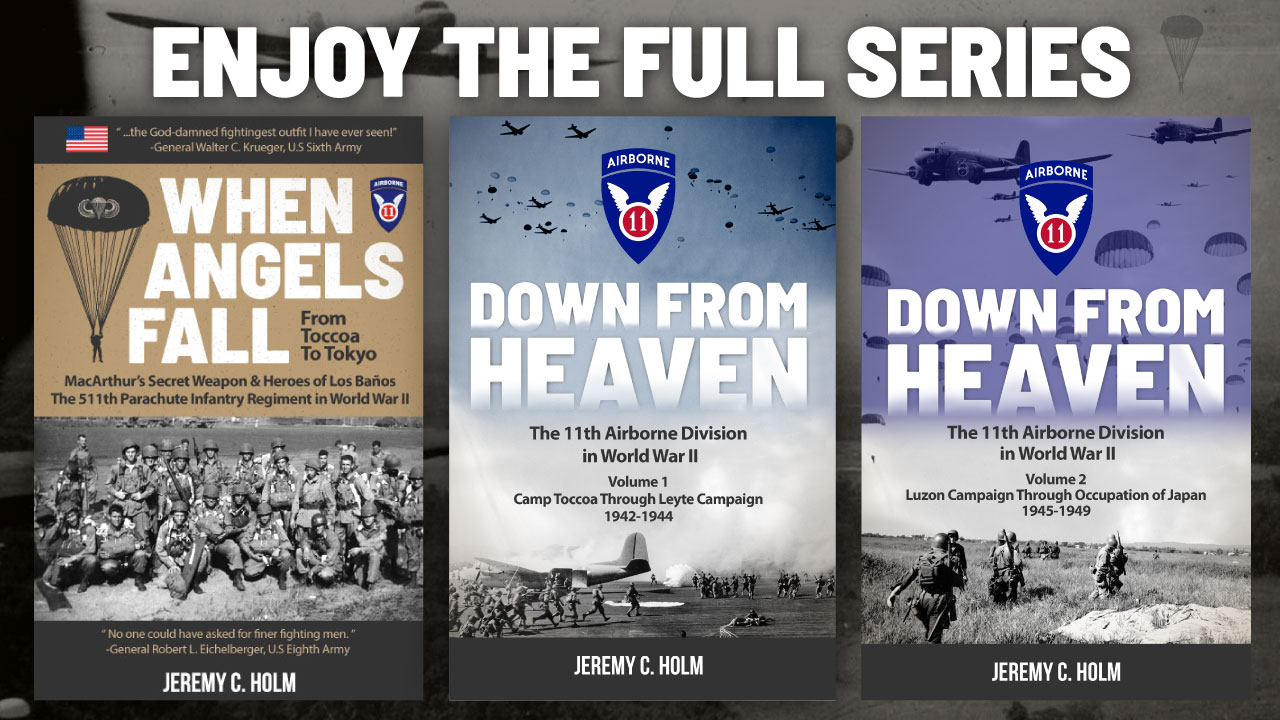
You can learn more about the 11th Airborne Division’s Leyte campaign in our books: WHEN ANGELS FALL: THE 511TH PIR IN WORLD WAR II, which is often called “The Band of Brothers of the Pacific”
And our two-volume series, DOWN FROM HEAVEN: THE 11th AIRBORNE DIVISION IN WORLD WAR II. Volume Three which will cover the Korean War is coming soon, so stay tuned.
All our books are available wherever history publications are sold, especially Amazon, although if you’d like signed copies, you can get those through our online store: 11thairbornestore.com. We have quite a few airborne related gifts and items in the store, so be sure to check it out.
And if you enjoyed this video, be sure to like and subscribe to this channel, and then share it with a friend.
We have a lot more history to share, but until then, thanks again for joining us today, we’ll see you in the next episode.
Down From Heaven, Comes Eleven!
Airborne All the Way.
-Jeremy C. Holm
To learn more about the 11th Airborne Division in World War II, please consider purchasing a copy of our books on the Angels: